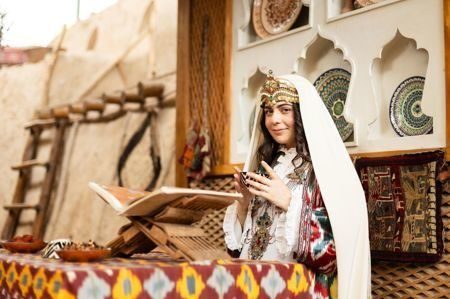


The Uzbek ethnic group is one of the oldest and most distinctive peoples in the world, and the largest ethnic group in Central Asia. The lands along the upper reaches of the Amu Darya and Syr Darya rivers and the foothills of the Tien Shan have always had a unique ethnocultural character that distinguished them from other regions of Central Asia.
As early as the 4th century BC, local communities began transitioning from a nomadic to a settled way of life. As a result, a distinctive cultural and social structure developed here at the dawn of civilization. It remained largely unchanged from the time of Darius and Alexander the Great until the 19th century. Even the Migration Period and the Turkic-Mongol invasions did not destroy the fundamental traditions and way of life of the local population. With the arrival of Islam, certain aspects of Uzbek culture underwent changes, but Islam became integrated into the existing local culture rather than replacing it.
The formation of the Uzbek ethnic group can already be clearly traced back to the 11th century, when agricultural oases inhabited by Turkic- and Iranian-speaking populations became united under the Karakhanid state. The formation of the Uzbek people as a distinct ethnic group was completed only in the 16th century, when nomadic Uzbek tribes, united under the leadership of the Shaybanid dynasty, moved into the central regions of Central Asia. From this period onward, the multi-ethnic proto-Uzbek population gradually became known by its modern name.
Traditional Uzbek clothing has remained largely unchanged since the beginning of the Common Era. Men traditionally wore and continue to wear straight-cut shirts and various types of robes, both lightweight and quilted with cotton, known as chapan.
Belts have traditionally served as an indicator of the wearer’s social status. Elaborately decorated or embroidered belts featuring silver ornamental plates and buckles, as well as pouches and purses, indicate the wealth of the wearer. Everyday belts, as well as those worn by poorer people, are usually simple long sashes or scarves wrapped around the waist, often in bright colors.
Uzbek men traditionally wear robes in rather subdued colors, although striped robes from neighboring regions can also be seen, as well as richly decorated robes featuring traditional embroidery. Trousers are traditionally loose-fitting, straight-cut, and slightly tapered toward the bottom. Women wear robes, long straight dresses made of khan-atlas fabric, and loose-fitting trousers.
There is also a complex system of expressing a woman’s social or family status through clothing and accessories. Traditional men’s headwear includes the kalpok, doppi (duppi), sanama, chizma, tahya, taykha, chumakli, kush, and kulokhi, various types of traditional skullcaps. Women also wear scarves, felt caps, and turbans.
Children’s skullcaps, such as kulokhcha, kalpakcha, doppi, and kulupush, are distinguished by their colorful fabrics, decorative tassels and pom-poms, embroidery, sequins, and numerous amulets. Skullcaps from different regions also vary in shape, patterns, and color combinations.
In recent years, Uzbek clothing has undergone significant changes under the influence of European culture, and it is now common to see people dressed according to the latest fashion trends. However, famous Uzbek embroidery and embroidered clothing, metalwork and jewelry, traditional headwear, and carpets remain considerably more popular than European-style innovations.
In a large Uzbek family, which traditionally consists of several generations of relatives living together, there is a well-defined hierarchy. Family relationships are based on respect for elders and obedience to the head of the family. Traditionally, a woman in the family has held a dual role: on the one hand, she is the wife and mother of the head of the family; on the other, she is expected to respect and obey both her husband and his parents.
In the past, girls were traditionally considered to be of marriageable age at 13–14. Today, legal marriage standards are in line with modern norms, although early marriages can still occur in some communities. Children are also highly valued and receive great affection within the family.

Religion, particularly Islam, plays an important role in the social and family life of Uzbeks. It has traditionally influenced everyday life, family relationships, worldview, politics, art, and many other aspects of society. Muslims are expected to pray five times a day (namaz), observe the daytime fast during the month of Ramadan, refrain from eating, drinking, and smoking until sunset, and give a portion of their income (zakat) to those in need or for charitable purposes. Muslims also observe Islamic holidays, particularly Eid al-Adha (Kurban Hayit).
Local traditions also include practices that differ somewhat from classical Islamic customs. For example, the pilgrimage to Mecca (Hajj) may, in some traditional contexts, be complemented or symbolically replaced by visits to local holy sites known as mazars. Special importance is attached to ceremonies associated with the birth and upbringing of children, such as beshik-tuyi and khatna-kilish, engagement (fatiha-tuy), weddings (sunat-tuy), food preparation (sabzi-tugrar), and many others. These ceremonies often combine Islamic traditions with older customs that predate Islam. Religious figures are traditionally held in high esteem and may participate in important community events. Friday is considered a special day, when Muslims gather at the main mosque for communal prayer. At the same time, Uzbek society is not generally considered highly religious or fanatical. Secular traditions remain an important part of everyday life, and the religious tolerance of the local population is widely recognized.
One of the traditional forms of social organization in Uzbekistan is the mahalla — a neighborhood community consisting of close neighbors and relatives. Mahalla residents traditionally support one another through mutual assistance known as hashar. A mahalla usually has its own mosque, local self-government, traditions, and cultural practices. Its importance is so significant that the mahalla is recognized as an important part of the country’s local self-government system.
One of the most deeply rooted traditions of Uzbek life is hospitality. The ability to welcome and treat guests is often valued more highly than the abundance of food or the material wealth of a family. It is generally considered impolite to refuse an invitation to lunch or dinner, and punctuality is especially important for guests. When visiting someone’s home, it is customary to bring a small souvenir or sweets for the children.
Respectable guests are usually welcomed at the gate. The hosts greet them, ask about their well-being and family, and invite them into the house. Guests are usually received in a spacious central room or invited into the courtyard. The local climate allows people to hold meals and gatherings outdoors for much of the year. Shoes should be removed before entering the living area.
The table, known as the dastarkhan, is usually arranged in the center of the room or, in the courtyard, under trees or in another shaded area. Guests are expected to follow the host’s instructions, although there is often a friendly and humorous exchange, as the host is equally eager to make the guest feel comfortable. Humor and politeness are highly valued during such interactions. The most honored places at the table are traditionally those located farther from the entrance or gate.
Traditionally, women did not always sit at the same table as men, although this custom is often not followed in modern urban settings. It is considered inappropriate to openly admire women’s appearance or pay them excessive attention at the table. However, asking about the well-being of the family and its members is perfectly appropriate.
In Uzbekistan, a meal traditionally begins and ends with tea. At first, sweets, pastries, dried fruits and nuts, as well as fresh fruits and vegetables, are served. These are followed by appetizers, and only later come plov and other hearty dishes. Uzbek plov is very filling and prepared according to a complex recipe, so it is generally better not to eat too much of it at once. Traditional dishes can also be rich, which is why green tea is commonly served throughout the meal.
Fresh, hot flatbreads are always present on the table. Traditionally, they should never be placed upside down. Dropping a piece of bread on the ground, or even placing bread directly on the ground while wrapped in cloth or paper, is considered a bad omen.
Tea and the tea ceremony occupy an important place in Uzbek daily life and hospitality. Preparing this essential national beverage and serving it to guests has traditionally been the responsibility of men, particularly the host of the household. Tea is brewed in small teapots and served in small bowls called pialas.
A distinctive tradition of Uzbek hospitality is serving only a small amount of tea at a time. The more honored the guest, the less tea is traditionally poured into their piala. This seemingly unusual custom has a simple explanation: repeatedly asking the host for more tea is considered a sign of respect and appreciation for the household. A partially filled cup naturally encourages the guest to ask for a refill. Therefore, repeatedly presenting an empty piala to the host is regarded as a gesture of respect toward the family. If some tea remains at the bottom of the piala, the host will usually empty it and refill the cup. By contrast, an uninvited guest may traditionally be served a cup filled to the brim.
Teahouse
The teahouse (chaikhana) is as integral to local traditions as tea itself
Social life traditionally revolves around mosques, bazaars, and, naturally, the chaikhana. People come here simply to socialize and conduct business negotiations, relax and share news, have breakfast and lunch, and discuss everyday concerns and broader issues of life and society.
Chaikhana are usually located in the shade of trees and close to water. Together with tea, this setting creates a calm and peaceful atmosphere for conversation. The interior of a traditional chaikhana is quite distinctive: low tables are surrounded by low sofas, usually covered with carpets.
In one corner, the owner or staff goes about their work, while the central feature is traditionally the hearth, where water is boiled or food is prepared, along with the teapots themselves.
The rituals accompanying tea drinking can be quite complex and unfamiliar to visitors. The easiest approach is simply to observe the locals and follow their example. Showing respect for local customs and traditions is always appreciated.
In everyday communication, Uzbeks are generally friendly, open, and informal. It is customary to shake hands when greeting people, including strangers and police officers, although traditionally men do not shake hands with women. During a handshake, people often ask about each other’s health and how things are going at work and at home.
When greeting women or people who are at some distance, it is customary to place the right hand over the heart and give a slight, respectful bow. It is also quite common to greet the same person several times a day, even if you have already met earlier.
Shoes should be removed when entering a home or a chaikhana. The dress code is generally relaxed, but when visiting religious sites, avoid clothing that is overly revealing or short. Wearing shorts is generally not recommended, especially in rural areas.